
Working Full Time and Still Coming Up Short: What the New ALICE Numbers Mean for Sarasota
New county-level ALICE data shows that 42% of Sarasota County households and 42% of Manatee County households can’t cover the basic cost of living. The same pressures behind those numbers show up every day in the work Harvest House does across our community.
The math doesn’t work – even when you do everything right
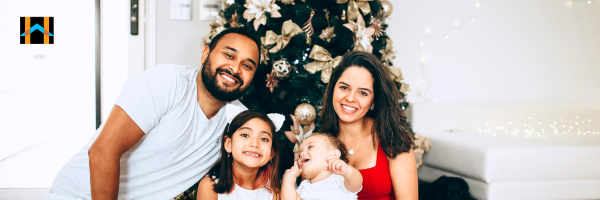
Picture two parents in Florida. One cooks in a restaurant. The other works as a bank teller. Both work full time, all year. Together they bring home about $71,000.
Now picture what it costs that family – two adults, a baby, and a preschooler – just to cover the basics: rent, childcare, food, a car to get to work, health care, a phone and internet, and taxes.
No vacations. No eating out. No savings.
Either way, the family is $15,000 to $20,000 short. Not because they’re doing anything wrong. Because the cost of living here has outrun what many jobs pay.
That gap is what the newest State of ALICE in Florida report measures. And it describes a lot of our neighbors.
What does ALICE mean?
ALICE stands for Asset Limited, Income Constrained, Employed. It’s a name for households that earn too much to be counted as “poor” by the government, but not enough to afford the basics where they live.
The official poverty line was set in the 1960s and is the same nearly everywhere in the country –
$31,200 for a family of four in 2024. It doesn’t account for what rent actually costs in Sarasota. ALICE does.
It builds a Household Survival Budget for every county in Florida, then counts how many households fall below it.
The report calls this a “survival” budget for a reason. It has no room for an emergency, a car repair, or a birthday present.
What the 2026 ALICE numbers tell us about Sarasota and Manatee Counties
The 2026 report uses 2024 data, the most recent available. Here’s what stands out for Sarasota and Manatee Counties, with Florida numbers for context:
- 42% of Sarasota County households live below the ALICE Threshold – 9% in poverty plus 33% who are ALICE. That is 94,833 of the county’s 225,791 households. In Manatee County, it is also 42% – 11% in poverty and 32% ALICE, or 82,835 of 195,453 households. Statewide, the figure is 47%, which ranks Florida 47th out of 50 states and D.C.
- And the number is growing. Sarasota County added more than 15,000 ALICE households between 2021 and 2024, from 58,796 to 73,865.
- A single adult in Sarasota County needs $41,316 a year – $20.66 an hour, full time – just to cover the basics. In Manatee County, it is $39,108 ($19.55 an hour). Both are higher than the statewide figure of $35,904.
- Raising kids here costs more than most jobs pay. A Sarasota County family of four with an infant and a preschooler needs $108,900 a year to get by, or $54.45 an hour on one income. In Manatee County, it is $100,416. Childcare alone for that family runs $1,875 a month in Sarasota County, nearly as much as rent.
- Housing is the biggest line item. The ALICE budget puts a modest one-bedroom in Sarasota County at $1,463 a month. Among Florida renters below the Threshold, nearly half spend 50% or more of their income on rent and utilities.
- Single moms and seniors carry the heaviest load. In Sarasota County, 73% of single-mother households with children are below the Threshold; in Manatee County, it is 80%. Nearly half of senior households in both counties – 48% in Sarasota and 49% in Manatee – cannot cover the basics either.
- Full-time work isn’t a guarantee. Statewide, a $20-an-hour job fell short of the survival budget in 99% of Florida counties, including ours.
What those numbers look like in real life
Statistics can feel distant. These are not.
They look like a housekeeper cleaning hotel room on Siesta Key. Statewide, 66% of housekeepers, 53% of cooks, and 46% of servers live in households that cannot afford the basics – the people who make Sarasota work for everyone else.
They look like a parent who gets paid on Friday and has already decided which bill can wait until the next one. The electric bill or the car insurance. Groceries or the prescription.
They look like a family that has an apartment today and knows one transmission repair or one ER visit could put it at risk. Across the Southeast, only 35% of households below the ALICE Threshold have three months of emergency savings. For households above the Threshold, it is 71%.
They look like a retiree on a fixed income watching rent and insurance rise every year while the check stays the same – nearly one in two senior households in Sarasota County.
None of these people are failing. They’re working, caring for family, and showing up. The budget just doesn’t close.
Why ALICE matters to Harvest House
The ALICE report describes the pressure. Harvest House sees what can happen when that pressure turns into a crisis and works alongside people to help them regain stable footing.
Most ALICE households will never need a shelter bed. But when the margin is this thin, a job loss, a health emergency, or an addiction can push a family from “barely making it” to “nowhere to go” faster than most of us realize. In 2025, 97% of the people who came to Harvest House arrived from chronically unstable living situations, and 71% of adults entered with no income at all.
Harvest House meets people at that point and builds back toward stability through:
- Emergency shelter and supportive housing for families, along with case management and life-skills classes.
- Residential addiction recovery for single adults in Sarasota and Manatee Counties – 243 adults served in 2025.
- Onsite, trauma-informed therapy, so mental health care isn’t one more thing a family can’t afford.
- Food security, with weekly grocery boxes and 23,300 pantry visits in 2025.
- Affordable and fair-market housing, so people have somewhere stable to go when they are ready.
Last year, that added up to 545 clients served in housing programs and community-based case management, 114,012 bed nights, and 156 children who were not homeless because of Harvest House. Of adults who entered, 70% left with income. And 100% of families who moved into permanent housing were still housed 180 days later.
That last number matters. Stability that holds is the whole point.
We’re well on our way to $500,000 – and every gift counts twice
Harvest House’s newest answer to the housing gap is Lakeview Village: 25 brand-new, 100% affordable rental homes in North Sarasota, next to Emma E. Booker Elementary.
The one-, two-, and three-bedroom homes are being built for working households earning 60-80% of the area median income – the teachers, social workers, first responders, and other neighbors the
ALICE report describes. Rental income from Lakeview Village will also help sustain Harvest House’s supportive housing for families for years to come.
More than $3.95 million of the $5.6 million project has already been secured, including a $1 million investment from the Charles & Margery Barancik Foundation.
Right now, there’s a way to close the rest of the gap faster. Thanks to Gulf Coast Community Foundation and its philanthropic partners, including the Elsa and Peter Soderberg Charitable Foundation, Bob and Lin Williams, and Kathy and Travis Brown, every gift to Lakeview Village is matched dollar for dollar, up to $500,000, through October 31.
A $50 gift becomes $100. A $500 gift becomes $1,000. The community has already given more than
$222,000 toward unlocking the full $500,000 match – and every dollar between here and the finish line is doubled.
This is what it looks like to turn a worrying number into a local answer.
Help us finish this
You’ve read the numbers. You probably recognized someone in them – a coworker, a neighbor, maybe your own family at a harder time.
Sarasota has already stepped up for Lakeview Village, and we’re well on our way. Until October 31, your gift goes twice as far.
GIVE TODAY & DOUBLE YOUR IMPACT
Together, we can finish this work and help more local working families find homes they can afford.
Frequently Asked Questions
What does ALICE stand for?
ALICE stands for Asset Limited, Income Constrained, Employed. It describes households that earn above the federal poverty level but still cannot afford basic needs in the communities where they live.
How many Sarasota County households are ALICE?
According to the 2026 State of ALICE in Florida report using 2024 data, 42% of Sarasota County households are below the ALICE Threshold. That includes 9% living in poverty and 33% classified as ALICE.
How much does a single adult need to live in Sarasota County?
The ALICE Household Survival Budget estimates that a single adult in Sarasota County needs
$41,316 per year, or about $20.66 per hour working full time, to cover basic expenses.
Why is affordable housing important in Sarasota?
Housing is the largest expense in the ALICE Household Survival Budget. A modest one-bedroom rental in Sarasota County is estimated at $1,463 per month, while many households below the ALICE Threshold spend a significant portion of their income on housing and utilities.
How does Harvest House help families experiencing housing instability?
Harvest House provides emergency shelter, supportive and affordable housing, case management, residential addiction recovery, trauma-informed therapy and food-security services for individuals and families in Sarasota and Manatee Counties.
What is Lakeview Village?
Lakeview Village is a Harvest House affordable housing development in North Sarasota that will provide 25 one-, two- and three-bedroom rental homes for working households earning 60-80% of area median income.
Are donations to Lakeview Village currently matched?
Yes. Gifts to Lakeview Village are being matched dollar for dollar, up to $500,000, through October 31, thanks to Gulf Coast Community Foundation and its philanthropic partners.